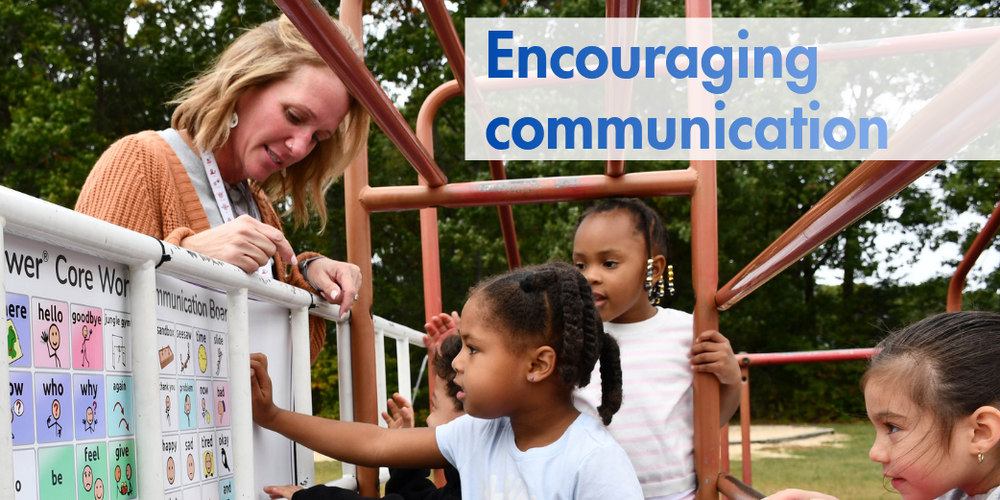
Core word boards are showing up on the playgrounds of CCPS elementary schools.
Similar boards have been used by Charles County Public Schools (CCPS) special education staff and adaptive technology teams for years. The low-tech tool is used by speech-language pathologists, educators, parents and caregivers to communicate with those who are non- or minimally verbal. However, the benefit of the board expands to almost all students.
“[The boards] are a universal support that can benefit all students by providing a visual way to communicate during play, social interactions, problem-solving and everyday activities,” Jennifer Fitzpatrick, a CCPS speech-language pathologist and assistive technology professional, said.
October is Augmentative and Alternative Communication (AAC) Awareness Month. In CCPS, assistive technology aids students who receive special education services who may need an auditory trainer, a magnifier, closed-circuit television and other tools like laptops, digital communicators and adaptive switches with lights, vibration and music.
Assistive technology comes in three categories — low-, mid- and high-tech. While digital tools fall into the high-tech category and battery-operated devices are among the mid-tech type, a printed, physical core word board falls into the low-tech group.
Boards include words that make up about 80% of typical daily conversations, inviting users to point out what they want to communicate. “By bringing communication supports onto the playground, CCPS is helping ensure that every student has opportunities to communicate, participate and connect,” Fitzpatrick said.
The board not only assists students with no or low verbal speech, it can help English language learners, those who use communication devices and any student or staff member who need to know what another person is trying to express.
Recess is unstructured but communication abounds. “It requires students to communicate constantly,” Elizabeth Heinmiller, a CCPS speech-language pathologist, said. “To take turns, ask for help, solve problems, make choices, interact with peers and follow safety expectations.”
The boards, which were donated by Malcolm Elementary School SOAR teacher, Kerry Carter, facilitate that communication. Carter works with students who are nonverbal or have limited verbal communication and uses core word boards in the classroom daily.
“I believe every student deserves the opportunity to communicate and be understood, regardless of their abilities,” Carter said. “I wanted core word boards introduced across CCPS elementary schools so students would understand that communication looks different for everyone and that not everyone uses spoken words to share their thoughts, feelings and needs.
The playground board program was first piloted last year at the F.B. Gwynn Educational Center and Dr. Thomas L. Higdon, Malcolm and Eva Turner elementary schools. Fitzpatrick estimated the boards will be installed at all CCPS elementary schools by the end of the school year.
The oversized boards resemble the more sophisticated communication tools students and staff use in class settings. But to the untrained eye, the outdoor version looks like an enormous bingo card with color-coded boxes featuring a word and corresponding icon.
The boxes with a purple background contain questions like What? When? Where? Verbs like Feel, Listen and Hurt have a green background while pronouns such as Me, My and Your are printed on a yellow square.
Students can point to a word to express themselves to a staff member or a peer. And if the board isn’t nearby or they are not on the playground, school staff have mini versions they can add to their badge lanyards. Fitzpatrick and Heinmiller visit schools to train staff on using the boards and lanyard cards.
Carter said it is just as important that staff know the importance of the boards and how to use them. “When staff understands how to incorporate these tools into daily interactions, students have more opportunities to communicate across settings and with different people,” she said. “By introducing core word boards to all students and ensuring staff know how to use them, we can create a school community where communication is everyone's responsibility. The goal is not simply to provide students with a board, but to build understanding.”
That understanding includes knowing that students who are nonverbal or have limited verbal communication still have something to say. “A student's ability to speak does not determine their ability to understand, learn, form relationships, or express opinions and preferences,” Carter said. “Our students have so much to share; we must ensure they have the tools and opportunities to express themselves.
When students have the tools they need to learn, they build the skills they need to grow.
“A core word board may look like a simple collection of words and symbols, but it represents something much bigger — an opportunity for every student to have a voice,” Fitzpatrick said. “When we make communication accessible, we open the door to connection, inclusion and belonging.”
Carter agreed. “Every student has something to say,” she said. “And it is our responsibility to ensure they have a way to say it."
About CCPS
Charles County Public Schools provides 27,904 students in grades prekindergarten through 12 with an academically challenging education. Located in Southern Maryland, Charles County Public Schools has 38 schools that offer a technologically advanced, progressive and high quality education that builds character, equips for leadership and prepares students for life, careers and higher education.
The Charles County public school system does not discriminate on the basis of race, color, religion, national origin, sex, sexual orientation, gender identity, age or disability in its programs, activities or employment practices. For inquiries, please contact Dr. Mike Blanchard, Title IX/ADA/Section 504 Coordinator (students) or Nikial M. Majors, Title IX/ADA/Section 504 Coordinator (employees/ adults), at Charles County Public Schools, Jesse L. Starkey Administration Building, P.O. Box 2770, La Plata, MD 20646; 301-932-6610/301-870-3814. For special accommodations call 301-934-7230 or TDD 1-800-735-2258 two weeks prior to the event. CCPS provides nondiscriminatory equal access to school facilities in accordance with its Use of Facilities rules to designated youth groups (including, but not limited to, the Boy Scouts).